Friday, February 17, 2023

Four Essential Questions In the Search for Meaning and Truth

Recently, on a podcast, I was asked what I'd like people to know about my faith. It wasn't a Christian podcast, per se, and it was connected to a secular university and the audience isn't necessarily Christian. I mean, I'm sure there are Christians listening, but its not a churchy podcast. I was given 5 minutes to share. Keep in mind, this is what I'd like people to know about the religion that I adhere to if I only had a few minutes to share with them, so its not entirely personal and there wasn't time to get into everything. So, I gave it some thought and this is how I answered: 

While many think of evangelical Christianity in a political, social, or cultural perspective, I think about the person and work of Jesus as the Son of God and Savior of the world. 

1. I believe there is a personal God who created everything and made us and is knowable. He isn't just a force or the universe or is unknowable, but he is real and reveals himself to us through Scripture and Creation and primarily through Jesus. 

2. I believe that men and women were made in God's image and have inherent worth, value, and dignity. We have purpose and identity that comes from God and we were made for relationship with God and right relationship with one another. 

3. However, something went terribly wrong. Mankind asserted themselves to be like God and went their own way. Instead of following God's ways, mankind promoted themselves, the relationship with God was broken, and they then began to turn on each other to climb over one another to assert their own worth on their own. They tried to create their own identity apart from God. This led to personal and then societal breakdown as competition turned to violence and things just kept going sideways. We call all of this sin against God, self, and each other. Everyone knows there is something wrong with us, but we disagree on what it is exactly. 

4. But, God loves us too much to leave us alone. He created us and wants us back in relationship with him. So, Jesus was sent to take our sin, break its power, save us and forgive us, and make us into new people so we can love God and love people instead of live primarily for ourselves at odds with God and one another. 

At the heart of Christianity is this message that because of the life, death, and resurrection of Jesus, our sins are forgiven. We receive this forgiveness and salvation by faith in Jesus and not in what we can do because our own efforts are inherently flawed and can't fix what ails us. We need a savior. Evangelical Christianity is supposed to be about how we are reconciled to God and one another through the the person and work of Jesus as he forgives us and makes all things new - including how we treat others. We can mess this message up and make it about other things because we are human and see point #3, but God's love for us is shown through the sacrifice of Jesus for us on the Cross. And, you can spend a lifetime exploring all that that means. 

Really, I believe that everyone on the planet is constantly asking and answering 4 essential questions. We all agree on the four questions, but we differ radically on the answers. The questions are: 

1. Who or what is God/gods or ultimate reality? What is the transcendent other beyond us? 

2. Who or what is mankind? What are we? What is our identity? Where do we fit in things? 

3. What has gone wrong with the world? What has gone wrong with us? Everyone on the planet knows that things are not as they should be. We differ on what things should be, but we all carry around in us this sense that something has gone wrong. 

4. How do you fix it? How do we solve our problems? Where does happiness and joy come from? How do we best live life? What is salvation? 

Those four questions are everywhere and they affect all conversations about meaning, culture, politics, and anything of a weighty nature. We engage in these questions all the time. They are spiritual questions and we're all constantly having what amounts to spiritual conversations, even if we don't recognize them as such. We differ in how the questions are framed and we really differ in how the questions are answered. As a Christian, I believe that we have answers to those questions. How and even whether we really live from those answers and they shape us becomes the quest of our lives.

The True Goal of Love for Enemies: Following Jesus


I once heard Stanley Hauerwas say that he was a pacifist not because he thought that by being a pacifist he would eliminate all war or violence or change everything. But, rather, he was a pacifist because he could not think of any other way to follow Jesus. I see that issue a bit differently than Hauerwas and, while I agree with nonviolence as a way of life, I don't ascribe to strict pacifism in that I believe that force is sometimes needed to protect the vulnerable and weak. I do not think that following Jesus requires us to be strict pacifists, but at the same time, I get his larger point. We don't take on an attitude or action because we think that by doing so we will change everything. But, rather, we live a certain way because that's what it means to follow Jesus as witnesses of his grace and love. We leave the results up to God. 

I started this point a few weeks ago on Martin Luther King, Jr. Day and I got distracted and didn't finish. But, I found the notes today and thought I'd pick up with the thoughts here. One thing that intrigues me about Dr. King's approach to nonviolence is that he wasn't just using it as a way to solve the problem of injustice against Black people. He looked to a larger goal of winning over enemies and creating Beloved Community. He didn't want revenge or recompense. He also didn't just want justice. He wanted reconciliation. He knew that violence would beget more violence and more alienation and the rift would just grow wider. Instead, he wanted to see healing and hope work to build something new where everyone could flourish. You can see the aspiration in these sermon excerpts ... 

Martin Luther King, Jr. on seeking to win over opponents instead of defeat them …

There are certain things we can say about this method that seeks justice without violence. It does not seek to defeat or humiliate the opponent but to win his friendship and understanding. I think that this is one of the points, one of the basic points, one of the basic distinguishing points between violence and non-violence. The ultimate end of violence is to defeat the opponent. The ultimate end of non-violence is to win the friendship of the opponent. It is necessary to boycott sometimes but the non-violent resister realized that boycott is never an end within itself, but merely a means to awaken a sense of shame within the oppressor; that the end is reconciliation; the end is redemption. And so the aftermath of violence is bitterness; the aftermath of non-violence is the creation of the beloved community; the aftermath of non-violence is redemption and reconciliation. This is a method that seeks to transform and to redeem, and win the friendship of the opponent, and make it possible for men to live together as brothers in a community, and not continually live with bitterness and friction.
from “Justice Without Violence,” April 3, 1957

But the end is reconciliation; the end is redemption; the end is the creation of the beloved community. It is this type of spirit and this type of love that can transform opposers into friends. The type of love that I stress here is not eros, a sort of esthetic or romantic love; not philia, a sort of reciprocal love between personal friends; but it is agape which is understanding goodwill for all men. It is an overflowing love which seeks nothing in return. It is the love of God working in the lives of men. This is the love that may well be the salvation of our civilization.
from “The Role of the Church in Facing the Nation's Chief Moral Dilemma,” 1957

Now, the tone of what he was saying in 1956-57 is a bit different from what he was expressing by 1968. King in 1968 saw more clearly the reluctance to change and grant justice to those who had been deemed inferior. But, he never forsake his commitment to nonviolence because it wasn't just a method to get what he wanted, but it was an expression of a larger ethic that was a core value - that those who opposed him could one day potentially be his friends. 

As I think of Jesus telling us to turn the other cheek, go the extra mile, and love and pray for our enemies in The Sermon on the Mount in Matthew 5, I do not just think that he is giving us a strategy to change the world - or even to change others. King saw nonviolence as a strategy to bring about social change. I agree with him and believe he was right to engage this way. But, I don't think that the result of this kind of life is that there will be no more cheek striking or load bearing or people treating each other as enemies. Sin continues within us and in society and it keeps bringing disintegration. Rather, I do think that for many when non-violence and sacrificial love is introduced as we see enemies as potential friends, the cycle of violence and retaliation will hit a barrier that will slow it down. Sometimes, it will stop it. I believe that human dignity and value will enter the conversation, at least in part. And, in many cases, enemies WILL be transformed into friends. But, more than all of that, I believe that those who walk down this narrow path will find that this is how they follow Jesus and give witness to the Suffering Servant and Crucified King, even when those around them do not. 

We don't love our enemies just because we think that by doing so we will obliterate all violence, oppression, and injustice. Or, even because by doing so we will win them over, though we hope we will. Rather, we love our enemies because Jesus loved us and we cannot conceive of any other way to follow him.  And, we also know that when we love our enemies, God's love flows through us to others, whether they receive it or not. And, that is enough. 

Wednesday, February 15, 2023

"We can love completely without complete understanding."


“Each one of us here today will at one time in our lives look upon a loved one who is in need and ask the same question: We are willing to help, Lord, but what, if anything, is needed? For it is true we can seldom help those closest to us. Either we don't know what part of ourselves to give or, more often than not, the part we have to give is not wanted. And so it is those we live with and should know who elude us. But we can still love them - we can love completely without complete understanding.”
– From the Rev. John Maclean in a sermon, as written by his son, Norman Maclean in his memoir, "A River Runs Through It and Other Stories."

The clip of the sermon and reflections from the movie:


"we can love completely without complete understanding." -- That's probably overstating things a bit. We love rather poorly even when we do have understanding. But, the impulse behind this still got me thinking ...

One of the hardest things I've had to learn over the years involves my complete and total inability to produce change in anyone else, even those I love deeply. Whether it be in my church or my family or among my friends or my community, those I love the most are those that I want what is best for and those I want to see change in the most. As a pastor and minister of the gospel, I have greatly longed to see people know God and walk with Him and have worked hard - devoted my life - to help people do that. I want my family to love Jesus and know Him. I try not to be pushy, try to be a real person, try to be available, compassionate, and at the same time, firm in my beliefs regarding what is true. But, as I've grown older, I've come to realize that change isn't a method and it's not really something that we can produce in others. Try as I might, I more often than not find myself bumping up against my human limitations. And, that sometimes frustrates me. But, then I think about how stubborn I am and how hard it is for me to change, apart from a miracle of God's Spirit, and I understand better. We are all just finite humans, limited and dependent upon grace.
I was thinking and praying about this today and the quote above from a sermon from Norman's father came to mind from the movie and the book, A River Runs Through It. In the movie, Rev. Maclean says this as he is grieving and reflecting on his son Paul's life, and death. No matter how much he tried to teach, lead, and direct his son, he couldn't save him from the direction he was headed. Paul was his own person making his own decisions with his own trajectory, his own agency. At the end of it all, all that Rev. Maclean could do was to give it to God and say, "but we can still love them."
Can I love others without being in control of them? Can I love others when they go another direction, disregard me, reject me? When they don't love me back? When my love doesn't "work" to produce change? Can I love others when all that I try to do for them fails or is ignored? As Christians, we have to ask ourselves these question regularly because our call is to love God and love people, everywhere we go. Even when they ignore you or don't receive it or listen or even when they oppose you. Because that is what Jesus did for us and it is His life that lives in us. The call to follow Jesus is the call to love. That isn't a sappy love that doesn't mean anything or that just accepts whatever someone does as good and true or that has no form. No, God's love is weighty and full of substance and character and hope. It is a love that stands rooted in who God is and His goodness and truth and lives sacrificially. The true love that transforms us flows out toward others and doesn't expect to be returned.
I've thought a lot about Rev. Maclean's reflection in that sermon. When I first saw that movie and read that book when I was in college, it struck me as a weak statement, as resignation. If we see someone flailing, we have to stop them! Rescue them! Change things for them! That's what love is, I thought. Strength requires intervention, leadership, change, rescue, turnaround. But, the older I get, the more that I realize that the real strength that Rev. Maclean was displaying was that of trust. He couldn't change the future for his son that he loved with his whole being. He tried, but could not rescue him. But, that didn't mean he would stop loving. And, if we offer that love, even if it is rejected, that is what is required of us. Our hope, after all, is in God.
And, ultimately, it is God who changes us. As Jesus said in John 3, "unless one is born again, he cannot see the kingdom of God.” And, "unless one is born of water and the Spirit, he cannot enter the kingdom of God." God has to do the work of making us alive, of opening our eyes, of saving us. Just yesterday, I was remembering a moment 30 years ago this month. I was a freshman in college at Mississippi State University. I had just been through a breakup with a girl I really cared for and I was quite discouraged. I was homesick and was considering transferring closer to home. I was incredibly lonely, not in church, not connected to other Christians. I had experienced salvation years before, and was a child of God, but I was living for myself and was headed nowhere, eighteen, alone, and rather depressed. It was a Friday night in the dorm and everyone was out but me. The dorm was quiet. I decided to finally get a shower, and it was in the dorm shower alone that I heard this still, small voice echo through my soul: "Your life was meant to serve Me. You'll never be happy unless you serve Me." It was God and it was like a thunder clap and lightening bolt all at once. It was a voice inside of me but outside of me at the same time. I was so far away from God, lost in myself and rebellion and pride and depression. But, out of nowhere and everywhere at the same time, God's Voice broke through it all and was strong and compassionate and hopeful and wise and full of direction. My problem was I was trying to serve myself. God reminded me in that instant that my purpose was to serve Him. I was looking for happiness apart from God. God spoke to me that my happiness would only be found in Him. Clarity broke through the fog and it was supernatural. I called my Dad and told him. He pointed me to Jesus. I started reading the Bible. But, in a few weeks, I began to drift, not knowing where to connect or how to live. But ... God kept coming after me. Again and again. Around 6-7 months later through a series of events, my life was transformed. But, it was that moment in the shower right at 30 years ago, February, 1993, that God broke through and I've never forgotten it. Later would come a more full commitment and then after that, a call to ministry. I wanted everyone to know this God who loves us and gave Himself for us.
My mistake, though, has always been when I take it upon myself to try and produce the change in others. Everyone needs an encounter with God. Everyone needs a touch from God's Spirit in that place of despair. We all need God's love to pour into our hearts and call us out from ourselves and into His light. I cannot produce that in anyone else. I can only point to Jesus who makes all things new. And, I can love without expecting anything back in return.
So, all of this reminds me that the greatest thing I can do is to love God, love people, pray for others, and ask God to work in the lives of the people I love - and those I don't yet know. We all desperately need to see Jesus, for God to break through, for Christ, by His Spirit, to make all things new.

Tuesday, January 31, 2023

Embracing Finiteness: We Cannot Be Whatever We Want to Be

"and He made from one man every nation of mankind to live on all the face of the earth, having determined their appointed times and the boundaries of their habitation," - Acts 17:26

"May you believe that the boundaries around your life are good and pleasant because God uniquely assigned them to you." - Kathryn Wolf

"A good man always knows his limitations." - Harry Callahan, played by Clint Eastwood in Magnum Force (1973).

Boundaries. Set places of habitation. Limitations. God is infinite, but we are not. 

Barnabas Osprey, in an essay entitled, "Coming to Terms with our Finite Existence", writes about finitude through the lens of French philosopher Paul Ricoeur. Ricoeur claimed that the "primary task of philosophy is to help us come to terms with our finitude."  Osprey explains how trying to escape our limitations can lead to all sorts of problems:  

Who doesn’t sometimes get angry, sad, or plain frustrated by their limitations? Wouldn’t we all rather have all knowledge, understanding, and power? But our limits are not something to regret, says Ricœur. The real problem is not that we are finite. The problem is that we wish we weren’t finite. In other words, that we want to be God.

This desire to be God is what led to the Fall, as outlined in Genesis 3. Osprey, working through Ricoeur's thinking says, 

Genesis 3 teaches that everything went wrong for Adam and Eve when they started to want to be like God. The status of not-being-God is not itself evil or sinful, but it does make evil possible if we refuse to accept our finite status ... We cannot change the fact that we are finite. Things will always happen to us that we didn’t want or choose. We live in a turbulent world in which we are not the master. No matter how intelligent, wealthy, or powerful we are, there are always factors beyond our control that can spoil our best-laid plans. The only choice we have is how we respond to our finitude. 

As I grow older, I recognize my finite nature more clearly. Becoming distinctly aware of your mortality doesn't just involve thinking about death. It also involves embracing limitations. I'm in my late 40s now and my children are growing up and leaving home. I have gray hair at my temples and I now wear glasses. The optometrist said that was normal for someone "my age." I've been blind in one eye since birth, so I have always had limitations on my sight, but now I need help with the one good eye. There are other signs of my finiteness beyond my flagging physical abilities. The future is becoming more narrow. I can see the ruts and grooves of my life more clearly in the emerging lines on my face and the view doesn't seem as wide open as it did when I was 20 years old. My course has been charted and set and I am well along my way in this journey of life. And it really is okay to admit that. It can be liberating, actually. I don't have to live on this constant upward trajectory to accomplish or do more. I can be at peace with who I am and trust God for what's next. 

This realization doesn't mean that things can't change or that I am powerless to make needed course corrections. I lost 70 pounds last year, started a doctoral program, I'm continuing to pastor a church, and I seek to love my children, wife, and community well, which requires constant learning, adaptation, and daily repentance from self-focus to others-focus. Change and growth are needed every day. But, part of that change involves learning what it means to be finite, limited, and unable to be all and do all that I'd like to do. I cannot be anything I want to be. I do not just "think and therefore I am" as Descartes said. My life is actually informed by time, energy, geography, seasons, relationships, and boundaries. Living in to who I really am and who God made me to be apart from expectations and comparisons with others is becoming more key as my life narrows. Context matters and I am more heavily influenced by my environment than I'd like to admit.

When my daughter was around five years old, I said to her, "Ashtyn, you can be whatever you want to be." I wanted to enlarge her thinking to dream big and reach for the life she wanted. She corrected me quickly: "No, Daddy. I am only supposed to be what God wants me to be." I was a bit taken aback at her wisdom. Our lives are only fully lived when we live into the life that God has for us. This isn't some kind of determinism where everything is set for us ahead of time and we have no choice or responsibility. Rather, it's more of growing into the awareness that God has set us into families and places and nations as our Creator and Designer and has given us bodies and minds and hearts. We live in the context of what God has done and is doing in our lives beyond us and in our lived experience. Truly, our lives are not our own and we are not the masters of our universe, able to create and recreate ourselves at will. Our future is not wide open just because we want it to be. We aren't a blank slate to be remade again and again. 

If this sounds a bit troubling and, well, limiting, it is because this perspective flies in the face of the modern zeitgeist. Western Individualism has many good aspects to it. It recognizes that people are unique and have value and have certain inalienable rights, and if it is connected to its source in the Hebrew theo-philosophical tradition, it finds that meaning in the Imago Dei; that mankind is made in the Image of God and bears the imprint of the divine upon his soul. But, this is worth, value, and dignity that is derived from a Creator and not just inherent in oneself. We are not God and we are not fully autonomous, no matter how far our fingers stretch toward a hoped for self-created future. We have limits and time teaches us that as it keeps marching on and eventually steals your strength, ideals, and aspirations. Try as one might to change the world, we find it hard to change even ourselves, much less the people closest to us. There are other forces at work and we are not as in control as we pretend to be. Things are rather out of control and that fear of loss, and ultimately death, drives us to cling more tightly to what we know, to our little distractions and escapes, and toward what we think we can create and preserve on our own. And, that fear can often turn us against others in our quest to protect and promote our own established "way of life." Individualism and its attendant anxieties can ultimately isolate and atomize our lives to the point that we fear threats to our autonomy and sense of control over an uncertain future rather than live with a healthy sense of hope. As isolation and fear grows, we look for tribes that will protect us from the "scary other" and polarization from others not in our tribe grows. The end of rampant individualism looks like isolation, fear, and grasping for tribal identities and leaders to protect us from what might be lost if our fear of losing control is realized. 

So what do we do? Osprey, in his further treatment of Ricoeur's philosophy, gives us some options in how we respond to our limitations. Either Refusal or Consent. Osprey continues:

Refusal means living in angry and bitter resentment against the things we can’t control. It means frustration, shaking our fist at the world and at God.

Consent means humbling ourselves to say ‘yes’ to whatever situation we find ourselves in, however difficult, however much it is not one we would have chosen. It means embracing our finitude and seeking contentment within the limits that have been given us. And for those who believe in a loving Infinite, consent also means trust. We trust that the origin and goal of all things is good, without any trace of evil. We trust that everything that exists is created by a loving Creator, and that therefore we were created, not for conflict and discord, but for peace and harmony with the creation and the Creator.

Embracing our limitations, our advancing age, our boundaries, and the fact that we are just a mist on the earth here today and gone tomorrow can actually be liberating. We can dig in deeper where we are and explore what God has given us, the relationships we have, and the wonder of the life we've been given. This is the "consent" that Ricoeur talks about. But, when we are constantly looking outward to extend ourselves beyond where we are and who we are, we can live disjointed lives disconnected from the actual life we have. We will either try to create a new life altogether through our own efforts (and that will often be applauded by others), or we can engage in escapism through seeking to dull the ache of daily living and distract ourselves from the lives who we actually. These are all forms of "refusal" as Ricoeur called it. 

Embracing Finiteness means that we find contentment in our Creator and the life that he's placed us in. Again, this doesn't mean that we settle for mediocrity or that we give up if things are going badly. We can make changes and strive for better things, but we do so as whole people made in God's image with a real substance to who we are, a real identity, a real past, a real context and setting and geography with real relationships and real limitations. All of those things inform who we are. They don't dictate our present or future and yes, Jesus makes all things new and saves to the uttermost. We must believe that. But, we are not the savior. We cannot recreate ourselves into something of our own imagination and we cannot escape our finite nature. We are the creature - the created, not the Creator. Life is lived best not through over-extension of the self into every realm that our imagination can take us into, but through embracing the blessings (and boundaries) that God has for us where we are, where He sends us, and through whom He sends to us. 

The Apostle Paul said, in Philippians 4:12-13, "I know what it is to be in need, and I know what it is to have plenty. I have learned the secret of being content in any and every situation, whether well fed or hungry, whether living in plenty or in want. I can do all this through him who gives me strength." We can be content in any and every situation through Jesus, who gives us strength. We don't have to change our identity or our circumstances to find wholeness and joy. We must be reconciled to our Creator who has the master plan for our lives, and we must be willing to embrace who we actually are in all of our limitations, flaws, weaknesses, and struggles and realize that there is grace for us. God sees us as we are and knows that we are but grass. He doesn't want us to fix ourselves or the world. He wants us to trust him. And that requires faith, not in ourselves and what we can do, but faith in God who makes all things new - and who redeems our lives and slowly, but surely, transforms us. 

There is so much more to say here and a thousand caveats spring to mind - and a hundred objections to my own words. I can hear the "but what about ..." from multiple directions. But, embracing my limitations, I'll stop here and cut off an already too long essay with the awareness that seeking to extend ourselves beyond ourselves causes us to live disjointed lives. We need to be rooted what is firm and stable and lasting. That starts with God and extends to the boundaries of the life He has placed us in as we lear to trust God to be in charge of our boundaries and to move them as He determines as He gives us grace for this life. 

Thursday, March 31, 2022

Migrants from Haiti and Around the World Build Up at Southern Border of Mexico


A focus of my doctoral work on missiology and intercultural studies is to consider how the church can engage with global migration as millions of people are on the move around the world. While this blog is primarily for devotional insights, it might be helpful to me to share thoughts on the topic of my studies as well. I’m convinced that global mission isn’t just about sending and going to the people “over there,” but it’s also about welcoming and receiving those who come to us from all over the world. Every town is a border town in that there are people there from many of the nations of the earth. But, for those who live on and traverse actual borders, there are more intense dynamics at play. 

How does the church live and minister in the borderlands? 

One place of focus is the border of Mexico and Guatemala at Tapachula in the state of Chiapas. Migrants from Central and South America and around the world have been coming though this border crossing for years.But, Mexico, doing work for the United States, has cracked down and is making it much harder to get across. The LA Times reports:

Southern Mexico has for decades been a way station for Central American migrants seeking to make their way to the United States. But in the last decade or so, Mexico has emerged as a signature transit country for migrants from across the globe, including the Caribbean, South America, Asia and Africa. About 40% of the migrants stuck in Tapachula hail from Haiti, where a series of natural disasters and political unrest over the last year have caused a mass exodus.

In an attempt to quell the near-daily protests in Tapachula, Mexican President Andrés Manuel López Obrador visited the city last week. He was greeted with a phalanx of migrants holding large wooden crosses, comparing their situation there to a crucifixion. 

López Obrador promised to grant roughly 950 humanitarian visas to migrants. The visa would allow migrants to stay in Mexico for a year and can be obtained only if a migrant has been granted refugee status. According to UNICEF, there are currently 30,000 migrants in Tapachula awaiting refugee status. The process can take many months.

The reality is that the movement of people through migration is a complicated process for the migrants, the countries they are passing through, and their destination countries. There is much anguish and pain encountered from leaving their homes to the journey to their destination. How can churches minister along the way? How can churches provide comfort and resources to people on the move? How can they show who Jesus is? That is happening in Chiapas and all along the migration routes in Mexico and at the U.S. - Mexico Border. I hear the stories. We have much to learn from these ministries. More on that later …


Wednesday, March 30, 2022

International Students in the U.S. a Legacy of International Mission Work?

 “Mission societies also sponsored the first international students to gain a higher education in Europe and the United States.”

Christian Mission: How Christianity Became a World Religion 1st Edition by Dana L. Robert

I’m reading this morning about the history and development of Christian mission around the world and I ran across this statement. There are around one international students in the United States today with around half of them coming from India and China. It has been said repeatedly that 75-80% of international students are never invited into an American home. I have been told that we are to welcome and minister to international students as a form of Christian hospitality, but I never considered that the whole program was started by Christian missionaries overseas years ago. When you see international students in the United States, also see that as a legacy of Christian foreign missions. 

Much of the world as we experience it now was shaped by Christians following the mission of God to take the gospel to the ends of the earth and who did hard work in various and diverse years ago. Now the nations have come to us and people are on the move all over the world with cultures colliding, what does that mean for Christian mission today? How should be see and receive people? What is God doing in these days to expand and replenish then church?


Tuesday, March 29, 2022

A Cross-Centered Theology for Suffering and Loss

Ray and Ruth Bozeman were an incredible couple. He was a World War Two veteran who served in the Pacific Theater in the Navy, was lost at sea, rescued, and was one of the first Americans on shore in the invasion of Okinawa. He returned home to Montgomery, Alabama and married the girl next door, Ruth Greene. They had to children and then in 1952, Ruth tragically contracted polio and was paralyzed in her legs and mostly paralyzed in her arms. She spent the rest of her life in a wheel chair. I say tragically, but Ruth's perspective on her predicament was that she was "blessed by polio" because it brought her closer to Jesus and taught her to trust God and live each day in the light of His blessing and strength, instead of her own. Ray and Ruth went on to live normal, yet remarkable lives as the loved God and loved people. 


I wrote a book about them published in 2015 called Joy Persevering: The Ray and Ruth Bozeman Story of Living in the Better Way of Jesus. In it, I tell their story and blend it with theological reflections on how they were able to live for Jesus and overcome adversity. There is a lot of narrative in the book as it really is a biography, but I also look for the work of God in their lives and dig down into how and why they were able to live the way they did. What follows is chapter 7 of the book, which explains how they were able to not just survive, but thrive in the midst of great suffering and difficulty. I hope that this can also help us think through what God is up to in the midst of what appears to be great defeat. 


Joy Persevering to Hope - Chapter 7 of Ray and Ruth Bozeman’s Story, Joy Persevering


Ray and Ruth continued to trust God and embrace life and the call to love God and love people sacrificially even though they faced real obstacles that would have caused many to give up or to withdraw into themselves and live small lives. When so many would have been overwhelmed, Ray and Ruth kept going, kept loving, and kept looking for what God had for them and how God wanted them to serve others. 


My premise is that Ray and Ruth lived this way because their perspective was rooted in seeking where God was working in and through all things instead of simply trying to figure out how they could make their lives better. This is why Ruth was able to say that she was "blessed by polio." Instead of seeing polio as a disability, she saw the difficulty as opening many more doors to knowing God and seeing life in a whole new way. Ruth would not have been Ruth without the polio just like Ray would not have been Ray without the obstacles he faced in the war and without Ruth's polio. Instead of seeing difficulty as something to run from and try to escape, they saw it as a refining fire that opened up possibilities to meet with God and be transformed by Him.


Our theology is important. We are all theologians because we all have a perspective and a belief about who God is and how He works. Being a theologian simply means that you are one who pursues a knowledge (ology) about God (Theos). We all do this whether we are aware of it or not. Ray and Ruth very clearly expressed and lived from a belief that God could be known through suffering and that life and joy could come out of suffering because God was at work to bring beauty out of ashes (Isaiah 61:3). Knowing Ray and Ruth as long as I have, I don't think that they simply clung to this belief as a comfort in hard times, but rather, I think that their knowledge of God as being most revealed in and through suffering was something that was at the bedrock of their faith. Otherwise, how can one say for over 60 years that they were blessed by polio and paralysis? 


Romans 8:26-31 gives a perspective on the Christian life that I believe Ray and Ruth embodied. It says, 


In the same way the Spirit also helps our weakness; for we do not know how to pray as we should, but the Spirit Himself intercedes for us with groanings too deep for words; and He who searches the hearts knows what the mind of the Spirit is, because He intercedes for the saints according to the will of God. And we know that God causes all things to work together for good to those who love God, to those who are called according to His purpose. For those whom He foreknew, He also predestined to become conformed to the image of His Son, so that He would be the firstborn among many brethren; and these whom He predestined, He also called; and these whom He called, He also justified; and these whom He justified, He also glorified. What then shall we say to these things? If God is for us, who is against us?


The prior section of Paul's letter to the Romans that begins with verse 18 says that the sufferings of the present time are not worth comparing with the glory that is to be revealed to us. It goes on to say that all of creation is subjected to frustration and groaning and is in bondage to decay. Why do bad things happen in the world? Why are there earthquakes and storms and disease and death? Why is there so much suffering? Because sin entered the world and with it, death. All of creation reflects this futility. We are broken and bad things happen. It isn't because of something that we did personally, necessarily. It is because the world we live in is broken down because of the presence of sin in it. When Adam and Eve sinned, they introduced death to the world and it has been wreaking havoc ever since. 


Jesus entered into that world and saves the world through His own suffering on the Cross. Jesus entered into our suffering, our pain, and our sin and took it upon Himself and broke the power of it. So, when we experience suffering and pain and sin, we have the opportunity to meet Christ who entered into all of that to save us in it, from it, and through it. Knowing Christ does not take away all suffering. Rather, He redeems suffering and turns it around. So, all of creation is waiting for redemption, which will happen when those who belong to God are revealed (Rom. 8:19, 23).


So, we are to live in hope because we know that God is at work in everything - even the difficulties and the groaning and the suffering. This perspective leads us to the verses that I quoted above in Romans 8:26-31. Because of all that God is doing, the Spirit helps us in our weakness (v. 26). We are weak. We do not see things as we should. We want relief and success and freedom from pain and suffering. But, we can't get it. We cannot secure the life we always wanted. Difficulties keep arising because we live in a broken world and we are a part of that broken world. So, what do we do? The Spirit of God prays for us with groanings too deep for words (8:26). You think that creation is groaning under the weight of present difficulty and expectation of future redemption? Yes, but the Spirit groans even deeper in prayer for us! We are not left alone in our difficulties.


It goes on to say that the Spirit intercedes for the saints according to God's will (8:27). I think that what is happening here is that the Holy Spirit prays for us in ways deeper than we can articulate and searches the mind and will of God and prays that we would know God's will and that our lives would be wrapped up in His purposes in spite of the broken world that we live in - actually, in the midst of the broken world so that the light of Christ can shine even brighter. 


Now we get to the core of it all. In verse 28 we see this amazing truth presented, that for those who love God and are called according to His purpose, all things work together for good. This does not at all mean that all things are good. There is evil and there is bad in the world and God is not the source of evil. There are things that happen that are terrible because of the world we live in. But, it means that for those who are in God, that all things are turned around so that good can come out of them. In other words, what we see here is the Cross event being placed into the middle of every bad thing for the believer so that good can come out of it. The Cross was a terrible event. The murder of the Son of God was the greatest sin ever committed. It was the greatest injustice ever perpetrated. But, the death of Jesus led to the salvation of the world. Good came out of bad. Life came out of death. Because the Cross revealed the very heart and character of God, the same thing will happen to those who are included in God and who have the Holy Spirit interceding for them. 


We then see that God has foreknown and predestined us to be conformed to the image of Christ so that we can be a part of God's family. We were predestined, called, justified, and glorified (Rom. 8:28-29). This is what God is doing. The purpose of our call and all that happens to us is so that we may be conformed to the image of Christ. We are to be like Christ. The good that comes out of the bad things that we go through is that God is working in our hearts to cherish Him more than the world, getting our way, having comfort, safety, security, prosperity, or health. There are greater things than the blessings we seek. Being conformed to the image of Christ is what we were created for and God will work good out of bad so that the result is that we belong to Him and find our home in His family. 


When difficulty comes and we yell out in pain and frustration to God, "Why are you letting this happen to me?!?" we reveal that our hope is not in God but in God causing our lives to go well. Now, I am not saying that we are wrong to want things to go well or that it is wrong to want to be blessed. God made us to want good things. Those desires are not wrong and can often lead us to God, if we understand them correctly. But, what I am saying is that we need to rightly see the world and our situation. Things are broken and we are not yet where we will one day be. Jesus entered into this broken world to bring salvation, but that looks different from what we expect. His salvation is not in keeping anything bad from ever happening to us, but it is revealed in meeting us in the difficulty and revealing Himself to us as the Creator and Sustainer God right there. God is greater than the blessings we seek. And, suffering in this broken world is the exact place where God reveals who He is so that we can know Him better.


Our vision is too narrow. On our own, we see only in the moment and we think that what is happening to us right then is the most real thing. This is why temptation to run after sin and other gods and other ways of living is so strong. We are constantly looking for relief and pleasure and satisfaction and our sinful nature has no ability to see where true salvation is found. So temptation to give up and live for ourselves is there when we face any kind of difficulty. But, God speaks something different. He says that we were made for more and in that moment of suffering and temptation when we are so prone to run to some lesser god, the Creator of the universe is praying for us and calling us to trust Him. The suffering is an occasion to trust God and be conformed to Him and for our character to be strengthened through valuing and worshiping God over anything else. It is in difficulty that this is revealed and where we meet with Christ who has overcome the world.  


This is why sacrificial love is so important. Scripture says that God so loved the world that he gave His only Son for the salvation of all who believe in Him (John 3:16). God loved so much that He gave His Son sacrificially as an atonement for our sin. This is not just an action of God. It is the very character of God made manifest. 1 Peter 1:18-21 says that Jesus was known before the foundation of the world but was made manifest to us in these last days as He shed His blood as a ransom for sinners so that our faith and hope would be in God and not in anything else. God revealed His heart and character through the sacrificial love and death of Jesus on the Cross and He wants us to see that love and entrust ourselves fully to Him. But, this is who God has been all along. Jesus, the lamb of God, was slain before the foundations of world were laid (Rev. 13:8) for sinners who would ultimately rebel against Him. This is what love is and the Cross of Christ is how God demonstrates His love to us (Rom. 5:8).  Since "God is love" (1 John 4:16), and His love was poured out to us through His suffering on our behalf and that love was present in God before the foundations of creation, we see suffering, sin, and difficulty as the occasions for that love to be made manifest. Likewise, we know that when we, as God's children, suffer in our own lives, we are in position to experience God's love in deeper and higher ways (Rom. 8:39) because the Spirit is praying for us in our weaknesses to reveal Christ to us. This is why we can count it all joy when we experience trials and suffer because the testing of our faith produces perseverance (James 1:2-3) and perseverance produces character and character produces hope and hope does not disappoint us because God's love has been poured out into our hearts through the Holy Spirit (Romans 5:2-5). So, in effect, it is through suffering that our misplaced passions are burned out of us and we most clearly come to know God and experience His love, which is greater than anything else.


When Ray and Ruth tapped into that fact and began to live according to the victory of Christ over darkness and suffering by joining Him in the suffering and giving their lives to Him and then loving one another and others sacrificially, they began to live according to God's design and will and were conformed to the "image of the Son." So, in their weakness, God's strength was revealed. This is God's plan for all of us. Then, Polio became a blessing instead of a curse as God redeemed the disease and used it for His glory and their good. 


All of this is counterintuitive to us. We can only see polio and paralysis as a blessing if we see God's revelation and the world according to the reality of how God revealed Himself on the Cross. The German theologian Martin Luther becomes helpful to us again at this point.  Luther came to so clearly see that God worked most through suffering because of the revelation of His character on the Cross that he called this perspective, the Theology of the Cross. Theologian Carl Trueman, in his essay, "Luther's Theology of the Cross" explains it this way:


The cross is paradigmatic [explains the way of understanding] for how God will deal with believers who are united to Christ by faith. In short, great blessing will come through great suffering.


This point is hard for those of us in the affluent West to swallow. For example, some years ago I lectured at a church gathering on this topic and pointed out that the cross was not simply an atonement, but a revelation of how God deals with those whom he loves. I was challenged afterwards by an individual who said that Luther's theology of the cross did not give enough weight to the fact that the cross and resurrection marked the start of the reversal of the curse, and that great blessings should thus be expected; to focus on suffering and weakness was therefore to miss the eschatological significance of Christ's ministry.


Of course, this individual had failed to apply Luther's theology of the cross as thoroughly as he should have done. All that he said was true, but he failed to understand what he was saying in light of the cross. Yes, Luther would agree, the curse is being rolled back, but that rollback is demonstrated by the fact that, thanks to the cross, evil is now utterly subverted in the cause of good. If the cross of Christ, the most evil act in human history, can be in line with God's will and be the source of the decisive defeat of the very evil that caused it, then any other evil can also be subverted to the cause of good.


Trueman is saying that the result of the Cross is not the absence or the removal of suffering from the experience of the believer, but rather, it is the subversion of evil as God causes good to come out of every situation and out of all suffering according to God's purpose of conforming us to the image of Christ. The Cross stands over suffering, failure, brokenness, rejection, and evil and subverts it and overcomes it and turns it upside down and inside out, causing all things to work for good for those who love God and are called by Him (Rom. 8:28-29).


Trueman goes on,


More than that, if the death of Christ is mysteriously a blessing, then any evil that the believer experiences can be a blessing too. Yes, the curse is reversed; yes, blessings will flow; but who declared that these blessings have to be in accordance with the aspirations and expectations of affluent America? The lesson of the cross for Luther is that the most blessed person upon earth, Jesus Christ himself, was revealed as blessed precisely in his suffering and death. And if that is the way that God deals with his beloved son, have those who are united to him by faith any right to expect anything different?


This makes it practical. When my eyes have been opened by the Spirit to what is happening in my life and the world around me, I become the most hopeful of all people. There is no defeat because no matter what takes place, God is working good out of it. Actually, it is in the difficulty that I will meet God and the most good will arise as I come to know Him better. This is why Paul could say in 2 Corinthians 12:9-10 that God's grace is sufficient because His power is made perfect in weakness and we are to boast in our weaknesses so that the power of Christ may rest on us even more. He says that it is because of Christ that he can be "content with weaknesses, insults, hardships, persecutions, and calamities. For when I am weak, then I am strong." This only makes sense if we work from a theology of the cross where life comes out of death. 


Trueman concludes:


Indeed, when it is grasped that the death of Christ, the greatest crime in history, was itself willed in a deep and mysterious way by the triune God, yet without involving God in any kind of moral guilt, we see the solution to the age-old problem of absolving an all-powerful God of responsibility for evil. The answer to the problem of evil does not lie in trying to establish its point of origin, for that is simply not revealed to us. Rather, in the moment of the cross, it becomes clear that evil is utterly subverted for good. Romans 8:28 is true because of the cross of Christ: if God can take the greatest of evils and turn it to the greatest of goods, then how much more can he take the lesser evils which litter human history, from individual tragedies to international disasters, and turn them to his good purpose as well...The cross is not simply the point at which God atones for sin; it is also a profound revelation of who God is and how he acts toward his creation.


One time when I was meeting with Ray and Ruth and their children, Barbara and Mike, and I was talking with them about the book, Mike looked at me and said that he did not understand why his parents, as good as they were, had suffered so much. Why did God let people like them go through what they have been through? He said that it troubled him all his life and he could not understand it. In that moment, I felt the weight of the question that he was asking. It is a question that we all ask and a question that I myself have wrestled with my entire life as I have seen people that I love suffer greatly.


Why do bad things happen to good people? Well, first of all, none of us are good apart from God. So, there's that. But, to get at the question, it is a mystery. And, that is ok. At least for me. I don't always even know why I do what I do. If I can't know my own mind, then how can I understand the workings of all creation? And, God does not reveal this to us. Scripture never tells us where evil comes from or why some get sick and others live a long, healthy life. But, what God does reveal is that for those who love Him and who are called according to His purpose, He will bring good out of bad things. Because of the Cross, He is always bringing life out of death and it is in the suffering that we learn to trust Him because He is there suffering with us and giving us His comfort, grace, strength, power, and love. If we belong to God, where else would we rather be than in His presence as He prepares a table before us in the midst of our enemies (Ps. 23:5)?


When I am trying to understand everything and pinpoint the origin of this good thing or that bad thing, what I am really saying is that I want to regain some form of control. If I can explain something, then I can understand it. And, if I can understand it, then I can regain a sense of control in the midst of chaos. But, God doesn't want us to be in control. He wants us to trust Him, even when things aren't going well for us. Especially then.


A.W. Tozer once said, "When I understand that everything happening to me is to make me more Christlike, it solves a great deal of anxiety.” We might not know why things happen, but if we turn to Christ, we can say along with Ruth that the thing that has happened, whether it is paralysis from polio or something else unforeseen, can actually turn into a blessing because Christ has been revealed to us in it and through it and "in His presence there is fullness of joy" (Ps. 16:11). Each difficulty and hardship is another chance for God to demonstrate His love and care for us if we would see it that way. This perspective might be shocking to others, but for the child of God, it is simply the way that we trust God day by day. 


None of this means that the difficulty that we are facing is not severe or not heartbreaking. The Bible never denies that life is hard. It also doesn't mean that God does not heal or miraculously change our circumstances. Of course He does! We see that all through Scripture as well. I am in no way advocating a grim fatalism that simply accepts our circumstances as inevitable while we try to just get along and grin and bear it. Ray and Ruth would not call for that either. They are two of the most dedicated and sincere prayer warriors that I know. They both constantly pray for people to be healed, to receive comfort, and for God to change circumstances for the better. And, they have seen many prayers answered! However, their faith is not in the circumstances changing or the prayers being answered the way they want. Rather, their faith is in God and they find their rest in Him. From that place of trust, they are able to ask for mercy and intervention. 


If polio has been any kind of blessing at all, it has been so that Ruth and Ray can know God better, learn to trust Him, and live with Christ as their focus. And, they have learned that to be the greatest blessing of all. 

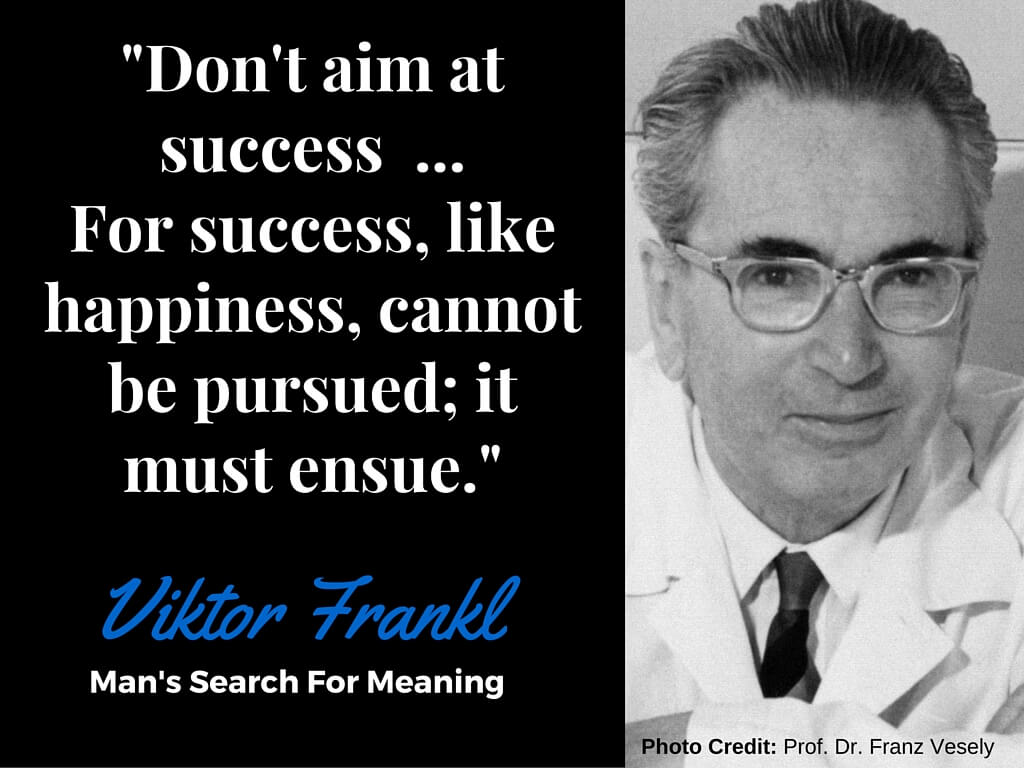
Viktor Frankl on Pursuing Success and Man's Search for Meaning

Viktor Frankl, in his best-selling book, Man's Search for Meaning, says that success is found not through its pursuit for its own sake, ...